

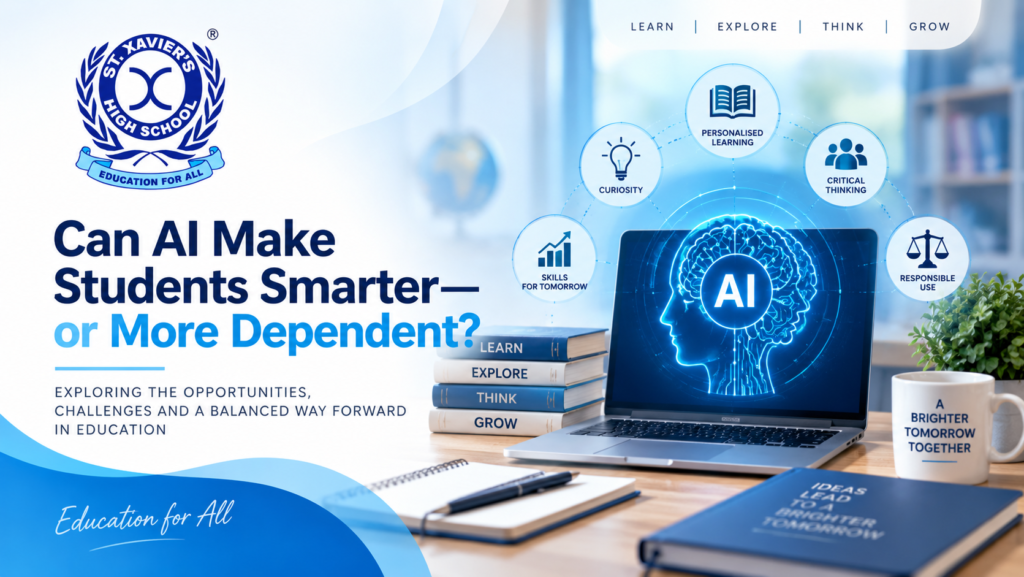
Artificial intelligence is becoming part of everyday life—and students are no exception. From finding explanations and generating ideas to solving problems and improving writing, AI tools can make learning faster and more accessible than ever.
But there is an important question parents and educators need to ask:
Is AI helping students become better thinkers, or is it slowly doing the thinking for them?
Used thoughtfully, AI can support curiosity, personalised learning, and problem-solving. Used without limits, it can encourage students to look for quick answers instead of developing the patience and skills needed to find answers themselves.
Every child learns differently. Some students understand a topic after one explanation, while others may need another example, a simpler explanation, or more practice.
AI can provide students with alternative ways of approaching a concept. A difficult science topic can be explained using an everyday example, a mathematical problem can be broken down into smaller steps, or a complex word can be explained in simpler language.
This can make learning feel more accessible.
Instead of asking AI for an answer, encourage them to ask:
The objective should be better understanding—not simply faster answers.
One of AI’s biggest advantages can also become one of its biggest disadvantages.
Students can receive an answer within seconds. But when every difficult question is solved for them, they may miss the opportunity to struggle, experiment, make mistakes, and discover the solution independently.
Learning does not always happen instantly.
Sometimes, the process of trying—and getting something wrong—is what helps an idea stay in a student’s mind.
If AI becomes the first option whenever a problem appears, students may gradually become less comfortable with thinking through challenges themselves.
A good learner does not simply look for answers. A good learner asks questions.
AI can make it easier for students to explore those questions.
A student studying space might begin with one question and then explore many more:
Why do planets orbit the Sun?
What would happen if Earth had no atmosphere?
Could humans live on another planet?
This kind of exploration can turn a textbook topic into a wider learning experience.
The important skill is therefore not just knowing how to use an AI tool. It is learning how to ask meaningful questions and evaluate the answers.
There is a major difference between using AI as a tutor and using it as a shortcut.
Consider these two requests:
“Write my entire essay for me.”
and
“Help me organise my ideas for an essay about this topic.”
The first can remove much of the learning process.
The second can help a student develop their own thoughts.
The same applies to mathematics, science, languages, research, and homework.
AI becomes more valuable when students use it to support their thinking rather than replace it.
Technology can provide remarkably polished answers, but students still need opportunities to make mistakes.
Why?
Because mistakes reveal where understanding is incomplete.
When a student attempts a maths problem before checking the solution, struggles with a paragraph before improving it, or experiments with an idea that does not work, they are developing skills that an instant answer cannot provide.
These experiences build:
A student who never gets the chance to struggle may know the answer—but may not know how to reach it.
The future will certainly require digital skills. But it will also require qualities that technology cannot simply provide for students.
Children need to learn how to:
A machine can generate possibilities, but students must learn how to decide which possibilities are useful, ethical, and appropriate.
That is why education must remain focused on the development of the whole child—not just their ability to use technology.
AI can sound confident even when an answer is incomplete, inaccurate, or unsuitable for the situation.
This creates an important new learning skill:
Don’t automatically believe an answer just because a machine provides it.
Students should learn to ask:
“How do I know this is correct?”
“Can I verify this information?”
“Does this answer actually make sense?”
“Are there other perspectives?”
Learning to check information is becoming just as important as finding information.
In a world where answers are increasingly easy to obtain, critical thinking becomes even more valuable.
One useful question for parents and teachers is:
“What can the child do independently?”
If a student can use AI to explore a topic but can also explain it without AI, that is a positive sign.
If they can receive help with a problem and then solve a similar problem independently, the technology has supported learning.
But if they struggle to write, reason, explain, or solve problems without an AI tool, it may be time to reconsider how they are using it.
The goal should never be to make students dependent on technology.
The goal is to help them become more capable because they know how to use technology wisely.
AI does not have to be treated as either a miracle solution or something that should always be avoided.
Like many powerful technologies, its impact depends on how it is used.
Parents can encourage healthy habits by talking to children about when AI can help and when they should think independently first.
For example, before using AI for homework, encourage your child to:
Most importantly, make sure technology does not replace conversations, books, hands-on activities, creativity, or real-world experiences.
AI is changing the way information is created, accessed, and understood.
Students growing up today will enter a world where intelligent tools are likely to become increasingly common. Preparing them for that world does not mean teaching them to depend on technology.
It means teaching them to question it, use it responsibly, check its limitations, and know when their own judgment matters more.
The most valuable skill may not be knowing how to get an answer from AI.
It may be knowing which questions are worth asking in the first place.
At St. Xavier’s High School, Dhenkanal, we believe education should prepare students not only for today’s examinations but also for tomorrow’s opportunities and challenges.
Technology can be a powerful learning aid, but it works best when combined with curiosity, critical thinking, creativity, communication, and independent learning.
Our aim is to encourage students to explore new ideas while developing the confidence to form their own opinions, solve problems, and make thoughtful decisions.
AI can give students more tools.
Education must teach them how to use those tools wisely.
If used thoughtfully, AI does not have to make students more dependent. It can help them become more curious, more informed, and more capable learners—while keeping independent thinking at the heart of education.
The future will belong to students who can work with technology without becoming dependent on it.
At St. Xavier’s High School, Dhenkanal, we are committed to creating learning experiences that encourage students to question, explore, create, collaborate, and think for themselves.
Want to learn more about nurturing a confident and future-ready learner?
Connect with St. Xavier’s High School, Dhenkanal, and take the next step towards building a learning journey that prepares your child for a changing world.