

St. Xaviers Dhenkanal

Why cartoons stick lessons fade

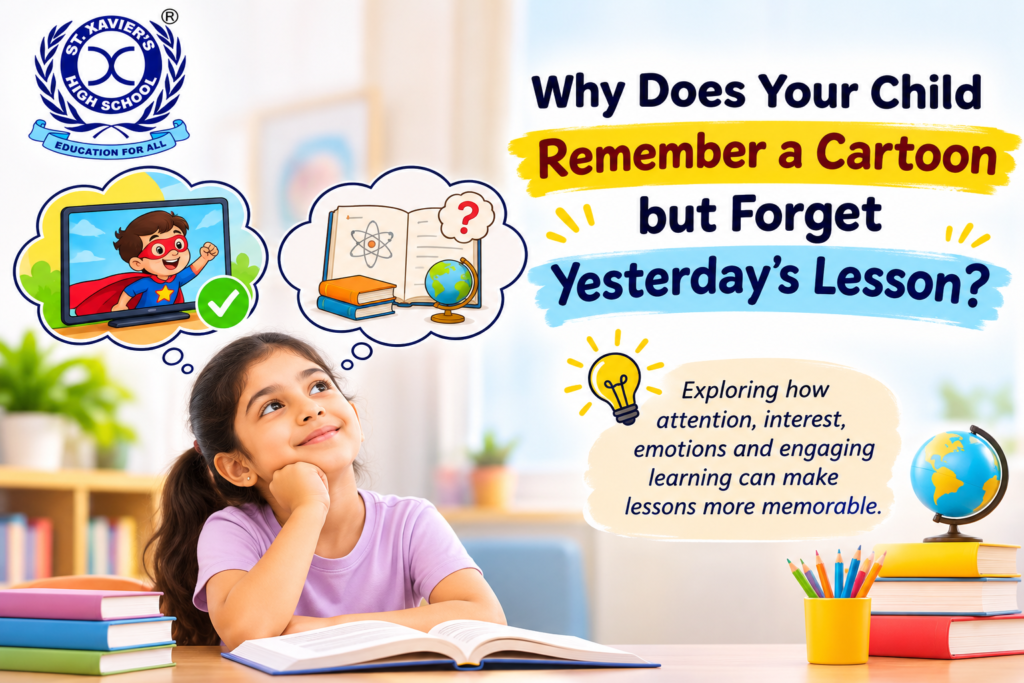
Why Does Your Child Remember a Cartoon but Forget Yesterday's Lesson?

📺 “I remember every character in my favourite cartoon!” “I know what happened in yesterday’s episode!” But when you ask, “What did you learn in school yesterday?” your child suddenly struggles to remember.

Sounds familiar?

Many parents experience this interesting situation. Children can remember cartoon characters, funny dialogues, storylines, and even small details from their favourite shows. Yet, they may forget something they studied just a day earlier.

Does this mean children have a poor memory? Not necessarily!

The difference often lies in how information captures their attention, connects with their emotions, and engages their minds.

Cartoons usually combine colourful visuals, interesting characters, humour, storytelling, and exciting situations. These elements can make information more engaging and easier to remember. Classroom lessons, on the other hand, may sometimes involve information that children find less interesting or difficult to connect with.

✨ The good news is that children can remember lessons better when learning becomes meaningful, interactive, and engaging.

In this article, let’s explore why children remember cartoons so easily, why classroom lessons sometimes slip from their memory, and how parents and teachers can make learning more memorable.

🤔 Why Do Children Remember Cartoons More Easily?

Have you noticed how children can describe an entire cartoon episode but struggle to recall a lesson they studied yesterday?

There are several reasons why entertaining content can capture children’s attention and make certain information easier to remember.

📺 1. Colourful Visuals Capture Attention: Cartoons use bright colours, expressive characters, animations, and interesting backgrounds. These visual elements attract children’s attention and help them connect images with information.

😂 2. Emotions Make Experiences Memorable: Funny, exciting, surprising, or emotional moments can leave a stronger impression. When children enjoy what they watch, they may be more likely to remember particular scenes and events.

📖 3. Stories Make Information Easier to Follow: Cartoons often present information through stories with characters, problems, and solutions. Following a storyline helps children connect different events and remember what happened.

🔁 4. Repetition Strengthens Familiarity: Children often watch their favourite episodes more than once. Repeated exposure gives them additional opportunities to recognise characters, remember dialogues, and recall events.

🎯 5. Interest Encourages Focus: When children enjoy a particular programme, they naturally pay more attention to it. Their curiosity encourages them to follow what is happening and understand the sequence of events.

However, remembering a cartoon does not automatically mean children have a better memory for everything. Attention, interest, repetition, and the way information is presented all influence what they remember.

🧠 Why Do Children Sometimes Forget What They Learn in School?

Forgetting is a normal part of the learning process. Children may understand a lesson during class but struggle to recall the information later.

Here are some common reasons why this happens.

📚 1. Learning Through Memorisation Alone: When children focus only on memorising definitions, answers, or facts without understanding their meaning, they may find it difficult to remember the information later.

😴 2. Lack of Attention: Distractions, tiredness, or difficulty concentrating can affect how much information children take in during a lesson.

📝 3. Limited Revision: Reading a lesson only once may not be enough for children to retain everything they have learned. Revisiting information at regular intervals helps strengthen memory.

💭 4. Difficulty Connecting Concepts: Children may struggle to remember information when they cannot relate it to familiar situations, everyday experiences, or previously learned concepts.

📱 5. Passive Learning: Simply listening to explanations or reading textbook pages without asking questions, discussing ideas, or practising can make it harder to recall information independently.

Understanding these challenges can help parents and teachers identify better ways to support children’s learning.

🚀 7 Ways to Help Children Remember Lessons Better

Improving memory does not always require longer study hours or additional homework. Sometimes, small changes in the way children learn can make a significant difference.

Here are seven practical ways parents and teachers can make learning more effective and memorable.

🌈 1. Turn Lessons into Interesting Stories

Children naturally enjoy stories. Connecting academic concepts with interesting situations can make lessons easier to understand and remember.

For example, while teaching a science lesson about the water cycle, explain how a tiny water droplet travels from a river to the clouds and eventually returns as rain.

Instead of simply memorising the stages, children can follow the journey and understand how the process works.

💡 Remember: A meaningful story can turn an unfamiliar concept into something children can easily relate to.

🎨 2. Use Pictures, Diagrams, and Visual Learning

Visual learning can help children understand information by connecting words with images.

For example:

🌍 Use maps and pictures while teaching geography.

🔬 Use diagrams to explain scientific processes.

📊 Use charts and illustrations to understand mathematical concepts.

📖 Use mind maps to organise important points from a lesson.

Visual aids can make complex information easier to understand, especially when combined with clear explanations and practice.

🎯 3. Encourage Children to Ask Questions

Learning becomes more meaningful when children actively participate instead of simply listening.

Encourage them to ask questions such as:

💭 “Why does this happen?”

🔍 “How does this work?”

🤔 “What would happen if we changed something?”

For example, while teaching about plants, ask your child what might happen if a plant receives sunlight but no water. Questions encourage curiosity, reasoning, and deeper understanding.

🔁 4. Make Revision a Regular Habit

Children may forget information when they do not revisit it after learning.

Instead of trying to revise an entire chapter in one sitting, encourage short revision sessions over several days.

For example:

📅 Day 1: Learn a new topic and understand its main concepts.

📅 Day 2: Spend a few minutes recalling the important points.

📅 Day 4: Answer a few questions without looking at the textbook.

📅 Day 7: Review the topic again and identify anything that needs more practice.

This approach, known as spaced practice, gives children repeated opportunities to strengthen their memory.

🎉 Small revision sessions can make learning more manageable and effective.

🗣️ 5. Encourage Children to Explain What They Have Learned

One of the simplest ways to check understanding is to ask children to explain a lesson in their own words.

After school, instead of asking only, “What did your teacher teach today?” try asking:

💬 “Can you teach me something interesting you learned today?”

💡 “What was the most interesting part of your science lesson?”

🌟 “Can you explain this topic using your own example?”

When children explain concepts in their own words, they practise recalling information and organising their thoughts.

❤️ 6. Connect Classroom Lessons with Everyday Life

Children often understand concepts better when they can see how those ideas work in the real world.

For example:

🍎 Use fruits to explain fractions.

🛒 Use shopping activities to practise addition and subtraction.

🌱 Observe plants to understand growth and photosynthesis.

⏰ Use everyday routines to understand time and measurement.

🌦️ Discuss weather changes to connect classroom science with daily observations.

These practical experiences help children understand that learning is not limited to textbooks or classrooms.

🏆 7. Make Learning Interactive and Fun

Children learn in different ways, and interactive activities can encourage them to participate more actively.

Try introducing activities such as:

🧩 Educational quizzes and brain teasers.

🎭 Role-playing and storytelling.

🎨 Creative projects and model-making.

🔬 Simple science experiments.

🤝 Group discussions and collaborative activities.

When children participate, experiment, and explore, they get opportunities to apply what they have learned rather than simply memorising information.

🌟 Remember: Learning should be an experience children enjoy, not just a task they complete.

👨‍👩‍👧 What Can Parents Do at Home to Improve Children's Memory?

Parents can support children’s memory development through simple everyday habits. Learning does not have to stop when the school day ends.

Here are a few easy activities to try at home.

📖 Encourage Daily Reading: Reading stories, picture books, and age-appropriate articles can help children improve comprehension and remember information.

🧠 Play Memory Games: Activities such as puzzles, matching cards, word games, and memory challenges encourage children to observe, recall, and think.

💬 Discuss the Day: Spend a few minutes talking about what happened at school. Encourage children to share interesting activities, new concepts, or something they discovered.

📵 Maintain a Healthy Screen Routine: Choose age-appropriate content and establish balanced screen habits. Make sure entertainment does not replace reading, outdoor play, homework, or family interactions.

😴 Encourage Proper Sleep: Adequate sleep is important for children’s attention, learning, and memory. Maintain a consistent bedtime routine appropriate for their age.

🥗 Provide a Balanced Diet: Offer nutritious meals, fruits, vegetables, and sufficient water to support children’s overall health and development.

❤️ Most importantly, avoid putting unnecessary pressure on children when they forget something. Give them time, encouragement, and opportunities to practise.

🏫 How Can Schools Make Classroom Learning More Memorable?

Schools play an important role in helping children understand, remember, and apply what they learn.

A classroom should not be limited to textbooks, explanations, and written examinations. It should also provide opportunities for students to explore ideas, ask questions, participate in activities, and connect knowledge with real-life experiences.

Teachers can make learning more engaging through:

📚 Story-Based Teaching: Using stories, examples, and relatable situations to explain academic concepts.

🎨 Visual Learning Resources: Incorporating diagrams, charts, presentations, and educational videos to support understanding.

🔬 Hands-On Activities: Providing opportunities for students to participate in experiments, demonstrations, and practical projects.

🧩 Interactive Quizzes: Using questions, puzzles, and classroom challenges to encourage active recall and participation.

🤝 Group Learning: Encouraging discussions, teamwork, presentations, and collaborative problem-solving.

💡 Regular Revision: Revisiting previously taught concepts through short activities and classroom discussions.

When students actively participate in the learning process, they get more opportunities to understand concepts, practise recalling information, and apply their knowledge.

At St. Xavier’s High School, creating meaningful learning experiences and encouraging curiosity can help students develop a deeper understanding of the subjects they study. By combining classroom instruction with interactive activities and practical experiences, learning can become more engaging and memorable.

🌟 Final Thoughts: Make Learning Something Children Remember

So, why does your child remember a cartoon but forget yesterday’s lesson?

The answer is not simply that cartoons are more entertaining. The way information captures attention, creates emotional connections, encourages curiosity, and gets repeated can influence how well children remember it.

Children need more than information presented to them. They need opportunities to understand, explore, question, practise, and connect what they learn with the world around them.

As parents and educators, our responsibility is to create an environment where learning feels meaningful and enjoyable.

✨ The next time your child remembers every detail of a cartoon but struggles to recall a classroom lesson, use it as an opportunity to make learning more interactive. Turn a concept into a story, ask an interesting question, or explore a practical activity together.

At St. Xavier’s High School, we believe that meaningful learning goes beyond remembering facts. It is about developing curiosity, understanding concepts, asking questions, and applying knowledge with confidence.

Because the goal of education is not just to help children remember what they learn today, but to help them understand it, use it, and carry that knowledge into tomorrow. 🌟

📢 Admissions Open for the Academic Year 2027–28!

Looking for a school that inspires children to learn, explore, think creatively, and grow with confidence?

St. Xavier’s High School, Dhenkanal provides an enriching learning environment where academic excellence goes hand in hand with creativity, curiosity, character building, and overall development.

We believe every child has unique potential, and the right learning environment can help them discover their strengths and achieve their goals.

✨ Give your child the opportunity to learn, explore, and create a brighter future with us!

Admissions are now open for the Academic Year 2027–28.

👉 Connect with us or visit our campus to learn more about the admission process.

St. Xavier’s High School – Nurturing Young Minds, Building Bright Futures! 🌟

Success Stories

Mrs. Supriya Chinara
Parent of Shreyash Suprajeet
Schools are the great place to learn and the school is the building which has four walls and tomorrow inside. My son Shreyash Suprajeet is in Class VII and studying from Class I in this school. Thank you for very nicely planned and organized academic program and good efforts by all teachers for encouraging my child's learning. The school is always support, cooperate and encourage him in studying as well as in all extra curricular activities. So I am very grateful to all teachers, principal and coordinator for my child is being groomed very well.
Mr. Kamalakanta Rout
Parent of Sonakshi Subhadarshini
I Dr Kamalakanta Rout working as AYUSH Medical Officer at Balarampur, Dhenkanal. My daughter Sonakshi Subhadarshini is studying in class - X at St. Xavier's High School, Dhenkanal. I selected this school for the ward's study for (1) This is the first and oldest school providing a CBSE course. (2) Past record of very good achievement of students in CBSE exams. (3) Parents like the behavior of all teaching and non-teaching staff towards students. (4) Giving special care towards extracurricular activities by students, helping then to express their inform qualities.
Mrs. Samina Subuelty
Parent of Sashree Priyadarshine
I am writing to let you know how very pleased I am with the education my daughter, Sashree Priyadarshine of class IV-B is. St. Xavier's High Receiving at School. Thank you for nurturing our child's love for learning. The dedication of the teachers and staff is commendable. Our child feels safe and supported at this school. We appreciate you and the school's staff for being role models for your students to emulate.
Mrs. Meenakshi Dash
Mrs. Meenakshi Dash
Parent of Sashree Priyadarshine
My son Sudaksh Dash, a student of class II, loves going to school and is doing academically well. What else do I need as a parent!! I sincerely thank the teachers for providing the environment that enables students to enjoy the learning process. I also thank the school management for giving parents the platform where we can express our opinions and give our feedback. I hope this continues.
Mrs.  sagarika Mishra
Mrs. sagarika MishraParent of Sai Samriddhi Nath
This school has given my daughter a great scope to grow. It's an amazing school, teachers are hard working and supportive. My daughter feel safe hear and i am very satisfied. A big thank you for all teachers who make them ready for higher stage performance. My daughter result very good bcoz the teaching style of all the teachers are fantastic and teachers giving the right guidance. Today I feel that my decision to send my daughter to this school was absolutely right. Thank you
Mrs. Sandhyamant Kande
Parent of Debyanshu Sahu
The st. Xavien High School is no more a school for me but a home in which my child spends 6 hours, daily with happiness. The teachers are very caring and their explanation. so good. So many extra Co-curricular activities have been taken on the school premises. I heartily thank everyone for giving so many chances to be My all-rounder.
Smt Satarupa Satpathy
Parent of Saranya Mishra, Std II-D
"Education is not filling of a pail, but lighting of a fire". - WB Yeats. St Xavier's High School, Dhenkanal, stands distinguished in its achievements in scholastic and co-scholastic areas with special stress on inculcation of strong values in children. May the school grow and move ahead in nurturing these blossoming buds to scale ecstatic heights.

Contact Us Now

St. Xavier’s School

School Address

author avatar
samarkswain